Protests took place in Tel Aviv, Jerusalem, Haifa, and Beersheba, as a survey found broad but uneven support among Jewish Israelis for Operation Roaring Lion.
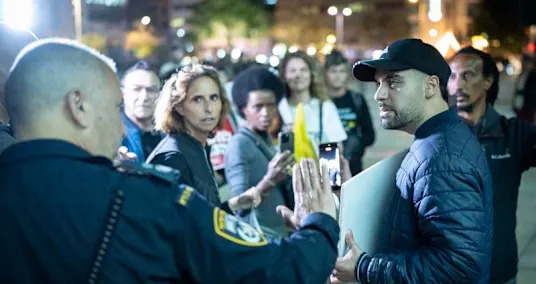
Israel Police arrested 21 anti-war protesters Saturday night as demonstrations against the conflict with Iran expanded in multiple cities despite restrictions on public gatherings.
Protests took place in Tel Aviv, Jerusalem, Haifa, and Beersheba, with hundreds of participants reported in Tel Aviv and Jerusalem and about 100 in Haifa, marking the largest turnout since weekly demonstrations began. Authorities said 13 people were arrested in Tel Aviv and eight in Haifa.
Police said the gatherings were not approved under Home Front Command regulations that ban events with more than 50 people. Officials said the increase in turnout followed calls by groups opposing the government to protest despite the restrictions.
“During a situation assessment that took place at the scene with a Home Front Command representative… it was clarified that there was a real risk to human life and accordingly, Yarkon [precinct] police commander Tzachi Sharabi ordered the gathering to be dispersed,” police said.
Hadash-Ta’al chairman Ayman Odeh, an Arab lawmaker involved in the protests, criticized the police response, calling officers fascists “in the service of the government” and saying they were afraid of “the heroic citizens who went out, despite everything, to make their voice heard.”

Survey shows broad, uneven support for war
The demonstrations come as a March 2026 survey by the Israel Democracy Institute found broad but uneven support among Jewish Israelis for Operation Roaring Lion. Support was strongest on the Right at 87% and about half on the Left.
The survey also found that Jewish and Arab respondents largely agreed that Iran’s resilience has been stronger than expected. Most Jewish respondents said Israeli society could sustain the campaign for up to one month, while 28% said as long as needed. Arab respondents were less optimistic about how long the public could endure the conflict.
A majority of Jewish respondents said Prime Minister Benjamin Netanyahu’s decision was driven by security considerations, while most Arab respondents viewed it as political.
latest_posts
- 1
 Figure out How to Use the Experience of a Fender bender Legal counselor for Your Potential benefit
 - 2The Delight of Camper Vans: Choosing the One That Meets Your Requirements
- 3Vice President Dick Cheney’s life followed the arc of the biggest breakthroughs in cardiovascular medicine
- 4Most loved Amusement Park for Small children: Which One Do You Suggest?
- 5AI is making spacecraft propulsion more efficient – and could even lead to nuclear-powered rockets


- Alice Wong, founder of the Disability Visibility Project, dies at 51
- Honda’s Biggest Flex Isn’t Its Superbikes, It’s Selling 500K Bikes In One Month
- Vote In favor of Your Favored Keeping an eye on
- 5 Great High-Mileage Electric Vehicles Of 2024
- Figure out How to Analyze Medical attendant Compensation Patterns Across Different Specializations
- 21 Incredibly Entertaining Contemplations To Observe Consistently
- Airport wait times won't return to normal until Congress reaches a deal to pay TSA. Here's why they still can't come to an agreement.
- 5 Eating routine Well disposed Snacks to Keep You Fulfilled
- Instructions to Warmly greet Certainty and Appeal