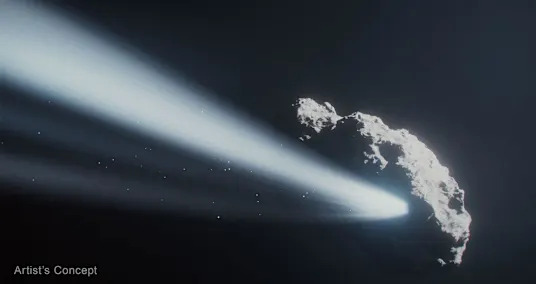
Astronomers have found archival data showing a one-of-a-kind event where a spinning comet appeared to reverse the direction of its rotation, NASA said in a news release.
The comet, named 41P/Tuttle-Giacobini-Kresák, originated in the outer solar system and visits the inner solar system every 5.4 years, NASA said. During a pass around the sun in 2017, its rotation dramatically slowed. A data comparison of its movements showed that in May 2017, it rotated three times more slowly than in March of that year.
Recently, NASA scientists conducted a new analysis of those observations and saw that the comet had made even more surprising moves. Images from December 2017 showed the comet spinning faster than in May.
Researchers determined that the comet likely continued slowing until it nearly stopped. Then, as it approached the sun, heat melted frozen ice on the comet's surface, creating "jets of gas" that "can act like small thrusters," said David Jewitt, an astronomer at the University of California at Los Angeles who published a paper about the comet's movements. The comet also had a small nucleus, making it easy for it to rotate.
Eventually, the jets' push against the original motion slowed it down until they eventually forced the comet to spin the other way. An animated video by NASA shows an artist's rendering of the process.

"It's like pushing a merry-go-round," Jewitt said in NASA's news release. "If it's turning in one direction, and then you push against that, you can slow it and reverse it."
Jewitt said he expects the nucleus will "very quickly self-destruct." Archival data from its 2001 passage shows the comet was very active at the time, and scientists were able to determine that activity had decreased significantly by 2017. The comet's surface may be evolving quickly, NASA said. Typically, comets evolve over centuries, but because of the comet's rotational shifts, the changes are happening faster.
Continued rotational changes might mean the comet eventually becomes unstable, potentially leading to its fragmentation or disintegration, NASA said.
NASA said the discovery shows the importance of the space agency's publicly accessible data.
"Observations made years, or even decades ago, can be revisited to answer new scientific questions," the agency said. "In many cases, scientists continue to make discoveries not just with new observations, but by mining the archive built over decades of space exploration."
Latest on jury deliberations in California social media addiction case
Trump reveals Iran apparently gifted the U.S. boats of oil that moved through Strait of Hormuz
Congress prepares to vote on DHS funding that could end TSA chaos
latest_posts
- 1
 EPA watchdog finds nation’s most contaminated sites are vulnerable to flooding, wildfires
 - 2In blow to Lula, Brazil Congress revives controversial environmental bill
- 3France to build new nuclear aircraft carrier, Macron says
- 4Opening Achievement: 8 Methodologies for Compelling Using time productively
- 5'Home Alone' actor Joe Pesci said 'no' to this stunt until he saw a 9-year-old girl do it, says director Chris Columbus



- December’s full moon is the last supermoon of the year. Here’s what to know
- As cases of a rare, deadly infection rise, doctors worry fewer teens will get vaccinated
- IDF destroys regime's missile, sea mine production site in Yazd amid nationwide airstrikes
- Two Endangered Bengal Tiger Cubs Die Days Apart at Zoo After Contracting Virus
- Help Your Business with Master Web based Promoting Arrangements
- 5 Pizza Fixings That Characterize Your Character
- Vote In favor of Your Favored Kind Of Bites
- Vietnam rethinks its flood strategy as climate change drives storms and devastation
- Instructions to Perceive and Grasp the Early Side effects of Cellular breakdown in the lungs